Guide · Organic Lemon Oyster grain spawn
Deutsch 🇦🇹
Lemon oyster grain spawn: how to use it
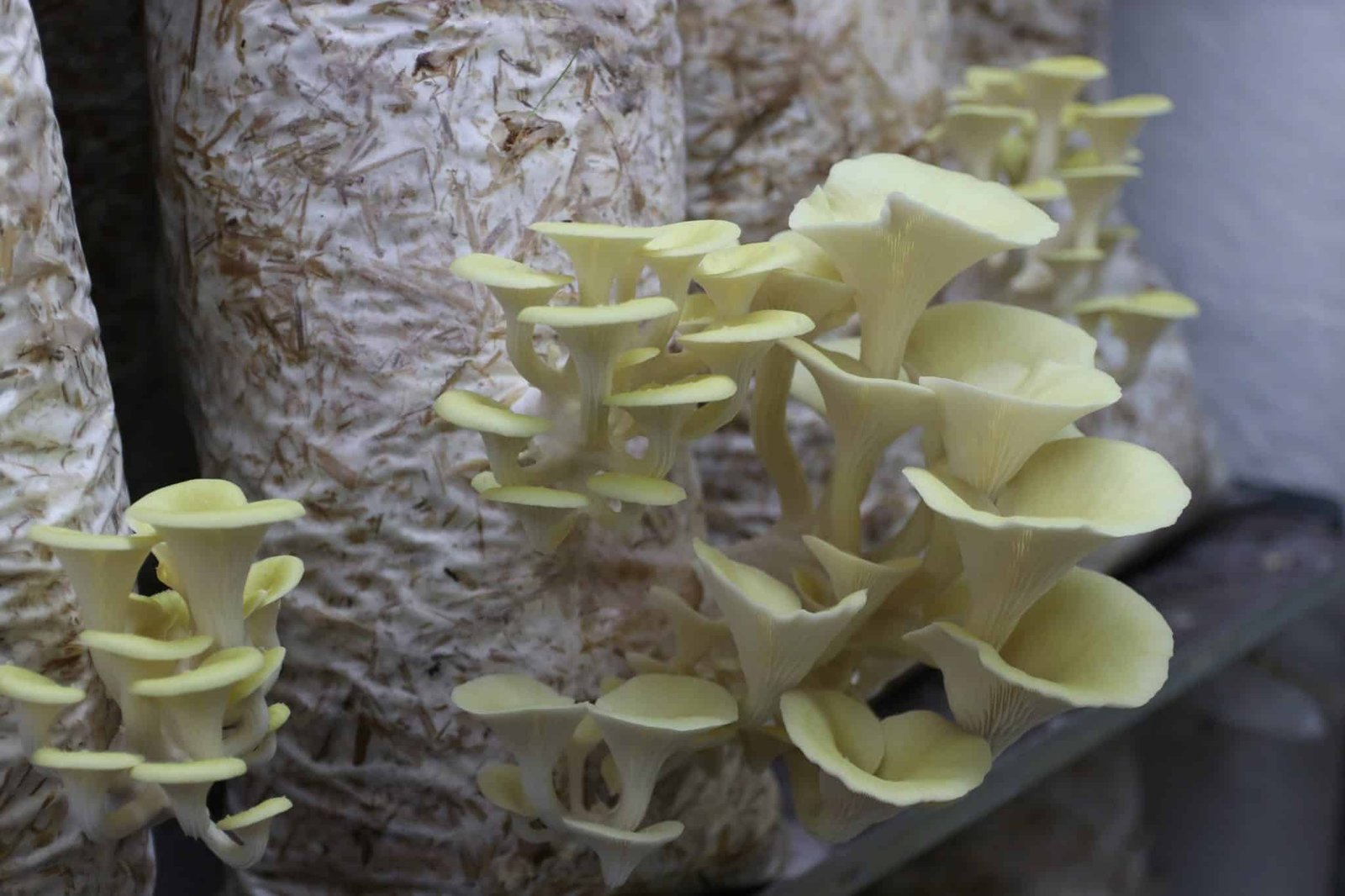
Bright yellow, slightly fruity in taste and a mushroom for warm temperatures: the lemon oyster is a real eye-catcher. Here are all the methods and the right conditions.
2 kg≈ 3.5–4 litres of spawn
approx. 20 kgmoist substrate per 2 kg
approx. 10 %spawn rate
1–2 monthsshelf life, chilled
The essentials
- Grain spawn is the “seed” for your mushrooms. It is mixed into a substrate such as straw, straw pellets, coffee grounds or hardwood sawdust.
- Keep it cool until use – ideally at 1–3 °C; in a fridge (4–8 °C) it keeps slightly less long.
- Rule of thumb: about 10 % spawn relative to the moist substrate, i.e. around 200 g spawn per 2 kg substrate.
- Only open the bag right before inoculating, and work with clean hands or gloves.
Storing and using it correctly
1. Chill it on arrival
Spawn is most vigorous when used fresh. If you don't need it straight away, put it in the fridge. Leave a little space between several bags – the mycelium keeps growing in the cold and produces heat.
2. Work out the amount
Allow about 100 g spawn per kilogram of moist substrate. So 2 kg of grain spawn inoculates roughly 20 kg of moist substrate. More spawn never hurts – the substrate colonises faster. If the spawn is a little older, use a bit more.
3. Work cleanly
The cleaner you work, the better the results. Wash and disinfect your hands or wear disposable gloves, clean your work surface and only open the spawn bag right before inoculating. Knead the bag first so the grains separate.
4. Inoculate and let it colonise
Mix the spawn evenly into the cooled substrate. The mycelium then grows out from every grain into the substrate. You'll find the conditions for colonisation below.
What you can use Organic Lemon Oyster grain spawn for
Pick the method that suits you – one click takes you to the detailed guide:
Straw pellets in bags
The easiest way to start: soak straw pellets with boiling water, let them cool, mix in the spawn and fill into bags. Perfect for indoors. Read the guide →
Straw in a bucket
Layer soaked straw and spawn in a bucket with holes – the mushrooms grow out of the holes. Read the guide →
Coffee grounds
Freshly brewed coffee grounds are already practically sterile and need no further treatment. Great for small batches. Read the guide →
Straw bales in the garden
Soak a straw bale, dig holes and fill them with spawn. 2 kg of spawn are enough for a bale of 50 x 50 x 100 cm. Read the guide →
Mushroom bed
Create a bed of straw, wood chips or sawdust in your garden and inoculate it with spawn – harvests over several seasons. Read the guide →
Hardwood pellets in filter bags
For wood-loving species: hardwood pellets (90 % wood, 10 % wheat bran, 1–2 % gypsum) in a mushroom filter bag. A bit more demanding, as the substrate needs to be very clean. Read the guide →
Logs
Grain spawn also works for inoculating hardwood logs, e.g. with the column method. The logs produce for years. Read the guide →
Tip from our practice
Lemon oysters come from tropical and subtropical regions and like it warm in cultivation too (16–25 °C). The mycelium tolerates light frost, but not hard frost. Mushroom beds are best started in spring. The mushrooms are very delicate – best used fresh.
Ideal conditions for Lemon Oysters
Colonisation
- Temperature20–24 °C
- Duration14–22 days
Fruiting initiation
- Temperature16–25 °C
- Humidity90–95 %
During fruiting
- Temperature16–25 °C
- Humidity85 %
- Fresh air (CO₂)< 1000 ppm
- Light800–1500 Lux, indirect
- Flushes2–4
Values from the book “Faszination Pilzzucht” by Sebastian Reindl (Stocker Verlag) and from our own practice at our mushroom farm in Schleedorf, Austria.
Troubleshooting
Green, black or pink patches
This points to contamination. Dispose of affected bags closed. Learn how to avoid it in common mushroom growing mistakes.
The substrate doesn't colonise
Common causes: substrate too warm when inoculated (above 35 °C), too wet or too dry, too little spawn or a room that's too cold. Tips in How to inoculate mushroom substrate.
No growth, or only weak growth?
Have a look at our FAQ or get in touch via our contact form – ideally with a photo. We are happy to help.
FAQ about grain spawn
What is the difference between grain spawn and a grow kit?
Grain spawn is the “seed” – you mix it into a substrate yourself. A grow kit is already fully colonised and produces mushrooms straight away.
How long does grain spawn keep?
1–2 months chilled, ideally at 1–3 °C. But use it as fresh as possible – that's when it grows most vigorously.
The spawn has grown together – is that a problem?
No, that's a sign of vigorous mycelium. Just knead the bag before opening until the grains separate again.
How much substrate can I inoculate with 2 kg?
At a spawn rate of around 10 %, about 20 kg of moist substrate.
When should I start lemon oysters?
Indoors all year round if it's warm enough. Outdoors in spring, so the mushroom fruits in summer.
Want more?
Reorder directly from us, discover more mushroom species or learn how to grow mushrooms yourself in one of our courses.
Questions? FAQ · Contact · All guides