
By Sebastian Reindl · Stoff’n e.U., Schleedorf · Mushroom growing and low-tech farming
If you’re seriously thinking about your own mushroom farm for the first time, you probably have a certain picture in mind: huge halls, high-tech machines and white protective suits. Or the exact opposite: a romantic forest shed with logs and moss. As so often, the truth lies somewhere in between, and it’s much more varied than most people expect.
People regularly ask to visit my farm in Schleedorf because they want to know what a mushroom farm actually looks like. I’m happy to show you, and to explain which factors shape it, whether at hobby scale or as a serious side business.
No two mushroom farms are alike
This is the first thing I tell anyone who wants to build a mushroom farm: forget the pictures on the internet. They always show one particular approach, usually the most spectacular. There’s no single answer to what a mushroom farm looks like.
At its core, every mushroom farm, whether on 15 or 15,000 square metres, needs more or less the same work areas: substrate preparation, inoculation, incubation and a fruiting chamber. What those areas look like depends on a handful of factors, which I’ll go through in turn.
Everything else, such as storage, an office and a cold room, comes later as the farm grows.
Factor 1: Size, from a cellar shelf to an industrial hall
Mushroom farms exist at every imaginable scale. At one end are hobby setups with a few blocks in a cellar or garage. At the other are fully automated operations with thousands of square metres of growing space. Many specialist farms lie somewhere in between: small to medium businesses that grow gourmet or functional mushrooms and sell them regionally.
What surprises many people is how little space you need to produce significant quantities. On a well-used 30 square metres, including inoculation, incubation and fruiting rooms, weekly harvests of up to 40–50 kg can be possible when everything runs smoothly. That’s a target for an experienced grower, not a starting point.
For hobby growers: A single cellar shelf or a converted wardrobe is enough to start. The microclimate in your fruiting area matters more than the floor space.
For aspiring professionals: Plan room for growth from the start. A farm that’s going well needs more space sooner than you think, and rebuilding later is expensive and annoying.

Factor 2: The species shapes the farm
Few factors affect how a mushroom farm looks as much as the species being grown. Different species need different substrates, containers and growing conditions, and that shows directly in the layout.
Oyster mushrooms
Oyster mushrooms grow outwards from the side, and they do well in hanging sacks, on straw bales or in buckets. A classic oyster mushroom farm therefore looks like rows of hanging or stacked sacks with mushrooms pushing out of the holes. Visitors often find this surprisingly organic, even a bit chaotic, but that’s exactly how it should be. See our oyster mushroom spawn.
Shiitake
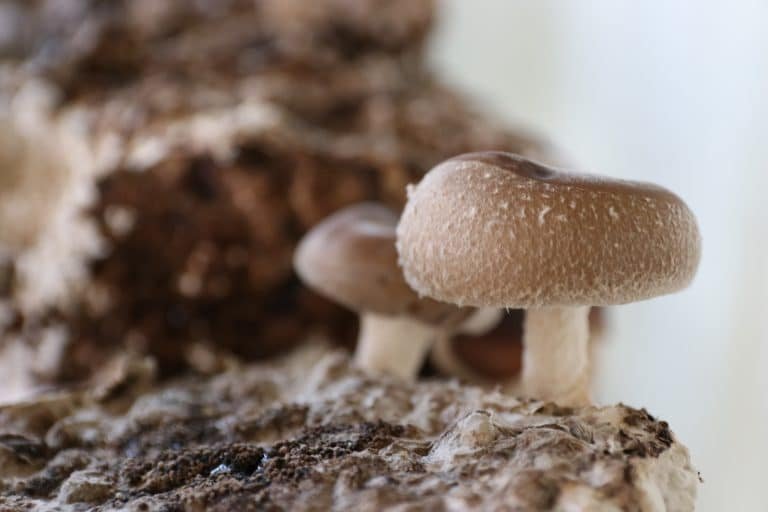
Shiitake farms use either blocks of hardwood sawdust or, traditionally, logs. Logs look more like a forest than a factory, with rows of them on racks or on the ground waiting to fruit. Sawdust blocks, by contrast, usually stand neatly on shelves in climate-controlled rooms. See our shiitake spawn.
Button mushrooms
Large button mushroom farms may be what most people picture as a “mushroom farm”: multi-level beds or metal trays covered in compost, with even white caps pushing up. These farms need very little light, so they feel dark and damp inside, almost like a cave.
King oyster, maitake and others
Speciality mushrooms such as king oyster or maitake are often grown in substrate blocks in climate-controlled chambers. The growing area looks like a tidy shelving system: cool and damp, with a light flow of air. It isn’t spectacular, but it’s very efficient. See our king oyster spawn.
What my farm in Schleedorf really looks like
I’m sometimes asked whether I share photos of my farm, and I’m happy to, even though it doesn’t look spectacular. There’s no glossy setting and no show kitchen. At Stoff’n in Schleedorf, you’ll see a down-to-earth organic farm that’s tidy, functional and low-tech.
The process starts with preparing the substrate: soaking straw pellets, pasteurising them and letting them cool. Then comes inoculation with organic spawn, in conditions as clean as possible. After that, the filled sacks or containers go into the incubation room, which is dark, warm and quiet. After one to three weeks, depending on the species, comes the crucial step: moving them to the fruiting room, where the light, humidity and CO₂ levels all have to be right.
What surprised me most in the early years was how unspectacular it all looks before the mushrooms start to grow. Inoculated sacks look like sacks. The incubation room looks like an empty room with sacks in it. Then, after a few weeks, life suddenly bursts out of the substrate, and that’s why it still isn’t boring to me today.
A mushroom farm also has a characteristic smell: earthy, fresh and slightly mushroomy. Visitors always notice it first. It isn’t a sign of a problem, but of living biology at work.

Factor 3: High-tech and low-tech are two different worlds
For me, this is the most important difference when talking about how a mushroom farm looks. A high-tech operation, like some large producers in the Netherlands, China or North America, looks like a pharmaceutical plant: automated filling and sterilising lines, computer-controlled climate systems, conveyor systems for bottles or bags, and very little manual work. It’s impressive, but irrelevant when you’re starting out.
A low-tech farm looks much simpler: basic shelves, plastic bags or buckets, a converted greenhouse or an insulated cellar room, and a simple watering system. That’s no disadvantage. Low-tech means less investment, easier repairs and more flexibility. For hobby farms or small side businesses, it’s simply the more sensible approach.
The basic process is the same in both: prepare the substrate, inoculate, let it grow, fruit and harvest. Technology changes the efficiency, but not the biology. Find out more about our low-tech mushroom farm coaching.
Practical tip: Before you build anything, visit other farms, even if they grow different species. You’ll learn an enormous amount by seeing it first.
Factor 4: Room layout and climate
When planning a fruiting room, people think of shelves and containers first. What really determines how a room looks and works, though, is the airflow. Mushrooms want fresh air, controlled CO₂, even humidity (85–95% for most species) and the right temperature. Where the doors are, where the fans hang and how the shelves stand all follow the airflow, not appearance.
In temperate climates like Austria’s, some species, such as oyster mushrooms, can be grown in a greenhouse or shed at certain times of year. This often works surprisingly well in spring and autumn, as long as the temperature doesn’t swing too much. Year-round growing does require a temperature-controlled room.
My biggest planning mistake at the start was putting the door on the wrong side. Every time it opened, dry air blew straight onto the crops. It sounds trivial, but details like that can make or break a harvest.
As for layout, hanging sacks need fixings in the ceiling and free access from all sides. Shelving saves space, but you have to think about air circulation between the levels. Both have their place, depending on the species and the rooms available.

Mushroom farm FAQ
How much space do I need for a small mushroom farm?
To get started, a single room of 5–10 square metres is often enough if you use the space well. Being able to control temperature and humidity matters more than size. Many people start in a cellar or an insulated garage.
Which mushrooms are best for a first farm?
Oyster mushrooms are the classic starting point: robust, fast-growing, tolerant of slight changes in climate and easy to grow on straw. King oysters are a little more demanding, but interesting for more experienced growers. Shiitake on dowel spawn is a good option if you want to work with natural logs.
Does a mushroom farm have to be dark?
Incubation doesn’t need any light. In the fruiting room, most edible mushrooms need a little diffuse light as a signal for orientation, not as a source of energy. Strong sunlight is a problem, because it lowers humidity and causes temperature spikes.
Can I grow mushrooms outside in the garden?
Yes. Some species, such as shiitake on logs or oyster mushrooms on wood in a garden bed, do well seasonally in Austria. The downside is that you depend on the weather and can’t harvest all year. For hobby growers, it’s highly recommended.
How much does it cost to set up a small low-tech mushroom farm?
That depends heavily on the rooms you already have. With a suitable cellar room, basic equipment (shelves, a humidifier, simple ventilation and your first spawn) is often possible for €300–800. If you need to prepare a room first, expect to pay more.
Curious about having your own mushroom farm?
Whether you want to start with a grow kit or build a low-tech farm straight away, at Stoff’n you’ll find organic spawn, supplies and practical know-how from Schleedorf.