By Sebastian Reindl · Schleedorf, Salzburg · Mushroom growing basics
Contamination is the topic nobody likes to talk about, but it affects every grower. I still remember my first big loss: a whole batch of grain spawn streaked green and black with Trichoderma. I was furious, and I learned a lot.
Contamination doesn’t mean you’re doing everything wrong. It’s a normal part of the process. What matters is recognising the most common types, understanding their causes and knowing what to change next time. This guide gives you an overview of the main moulds, bacteria and pests, and what you can do about them.
What does contamination mean in mushroom growing?
Contamination means any unwanted organism that settles in your substrate, spawn or growing chamber and pushes out or damages the mushroom mycelium. That can be mould, bacteria, insects or tiny mites: anything that isn’t your cultivated mushroom but takes hold anyway.
Contaminants thrive in the conditions we create for mushrooms: moisture, warmth and nutrients. That’s what makes them so persistent, and a small mouldy patch can spread quickly through a jar of substrate.
Contamination falls roughly into four categories: fungal contaminants (moulds), bacterial contaminants, pests such as mites and insects, and, more rarely, mycoviruses, which infect the mushroom mycelium directly.
Good to know: Contamination doesn’t automatically mean everything is lost. If you catch it early, you can sometimes save what’s left. Spotting the signs early is what counts.
Moulds: the most common contaminants
Moulds are by far the most common cause of crop failures in mushroom growing. Their microscopic spores float in the air, settle on surfaces and can germinate quickly when conditions are right. If you know what you’re dealing with, you can react faster.
Safety note: Mould spores can be harmful to breathe, and some moulds, including Aspergillus, are a particular concern. Don’t open badly contaminated bags indoors.
Trichoderma: the green nightmare
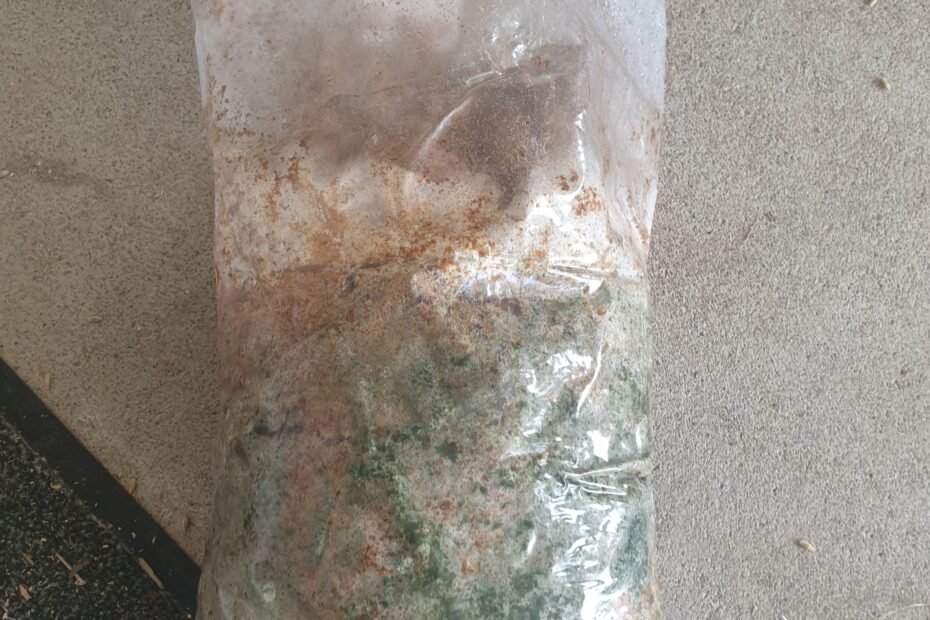
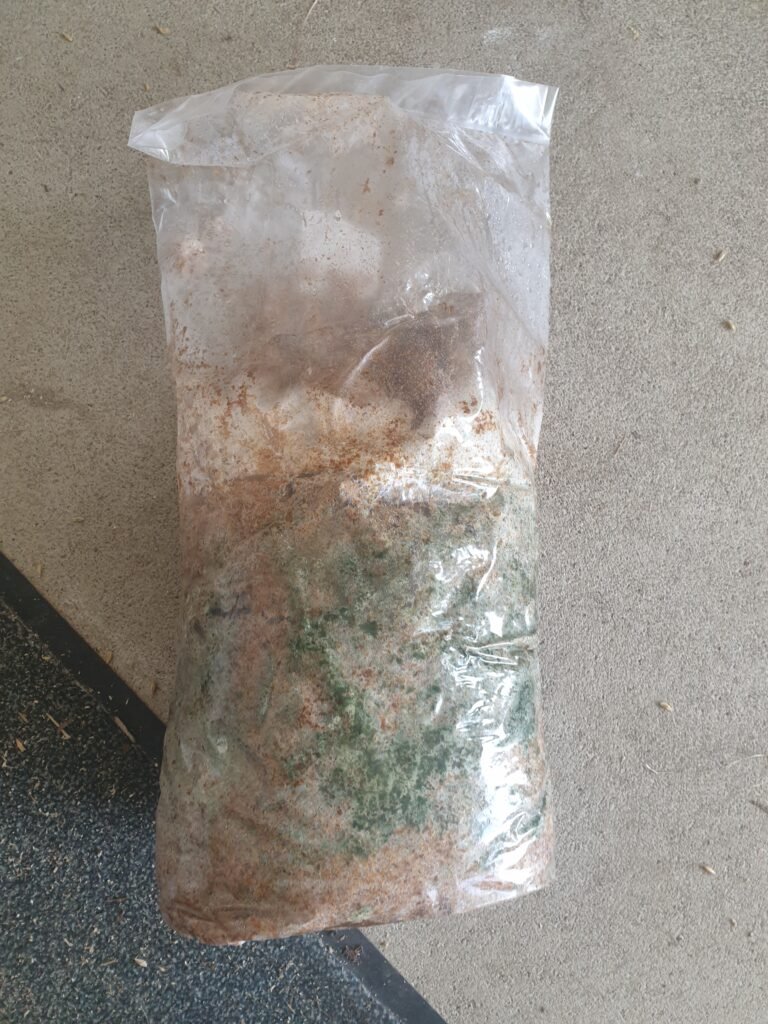
Trichoderma species are probably the best-known pest in mushroom growing. At first, the mould grows as fluffy white mycelium across the substrate surface, which makes it hard to tell from mushroom mycelium at this stage. Only when the blue-green spores appear can you identify it clearly. By then it has usually won: Trichoderma produces enzymes that break down the cell walls of mushroom mycelium and kill it. Remove it immediately and disinfect the area around it.
Aspergillus: hard to spot early
Aspergillus species come in many colours, including grey, yellow, green and black. Their mycelium starts out pale grey and thread-like, much like mushroom mycelium, which makes early detection difficult. Aspergillus is widespread indoors, in dust and in soil, so the risk of introducing it during inoculation is high.
Orange bread mould (Neurospora crassa)
This contaminant is especially aggressive and is among the fastest-growing moulds known. Its bright orange colour is unmistakable. It appears regularly in moist substrates, especially straw and coffee grounds. Once it’s producing spores, carefully seal it in a plastic bag and dispose of it right away. Don’t shake it.
Cobweb mould
Cobweb mould forms grey-white, cotton-like threads across the substrate and has a distinctly musty smell. It loves stale air and high humidity. It often appears shortly before fruiting and can make pins abort. In the early stages, many growers spray it with 3% hydrogen peroxide solution, which usually doesn’t harm the mushroom mycelium.
Tip: Penicillium (white-green and circular) often shows up on agar plates and in grain jars, but it’s less of a problem once spawn is in the substrate. If it appears after pinning, it usually has little effect on the harvest.
Bacterial contamination: wet rot and brown spots
Bacterial contaminants are often less obvious than mould, but just as damaging. They love moisture and thrive in the same conditions as mushroom mycelium.
Bacillus species: sour rot
Bacillus is the most common bacterial contaminant in mushroom growing. It appears as a slimy grey patch at the bottom of the jar or tub, smells distinctly sour and spreads from there. The problem is that Bacillus endospores are extremely heat-resistant and can survive a sterilisation cycle that’s too short or doesn’t heat the grain all the way through. Many growers soak grain at room temperature for 12–24 hours before sterilising. The idea is that the spores germinate and are then easier to kill in the autoclave. If Bacillus keeps coming back, also check your sterilisation time and consider sterilising longer or in smaller batches.
Pseudomonas species: brown spots on caps
Pseudomonas bacteria occur naturally in the environment. They become a problem when water droplets stay on mushroom caps for too long. Species such as Pseudomonas tolaasii then multiply and produce a toxin that damages the cells of the mushroom, causing brown and later slimy spots. The simplest countermeasure is good air circulation, so that water dries quickly.
Mites, flies and nematodes
Animal pests are often underestimated in mushroom growing, because many are microscopic. You often only notice them once the damage is done.
Mites
Several types of mite can occur in mushroom substrates. Tarsonemid mites feed on mushroom hyphae, and a heavy infestation can show as reddish-brown discolouration at the base of the stem. Tyroglyphid mites also feed on mycelium and leave small holes in the caps, which then let bacteria in. So-called red pepper mites feed on moulds and can spread Trichoderma spores throughout the growing area. Correctly pasteurising the substrate is the most effective prevention.
Fungus gnats (Sciaridae) and gall midges (Cecidomyiidae)
Fungus gnats are found in every garden and reach mushroom rooms faster than you’d like. Their larvae eat mycelium and bore into mushrooms. Adult gnats also carry mould spores from block to block. Gall midges are less common, but their larvae can multiply explosively and stick to tools, which carries them from one growing area to the next. Insect screens, sticky traps and good room management all help.
Nematodes
Nematodes are found mainly in compost or manure-based substrates, and you can’t see them with the naked eye. The first sign is mycelium that’s receding: the substrate looks colonised but produces no pins. Here too, correct pasteurisation is your protection.
What I’ve really learned about contamination
I remember a batch of grain spawn from earlier in my growing career. The autoclaving was correct and the inoculation seemed clean, yet after two weeks half the jars had Trichoderma. After a long search for the cause, I found that my laminar flow hood had a filter that was long overdue for replacement. A band of two or three centimetres around its edge was letting unfiltered air through. That was enough.
Since then, I’ve checked filters regularly and stuck to replacement intervals more consistently. I also changed how I soak grain. I used to cut this step short sometimes. Since keeping to a 12–24-hour soak, I’ve had far fewer Bacillus problems in my jar batches.
Another thing I used to underestimate is fungus gnats. In Schleedorf we battle them in summer, and for a long time I thought insect screens and a little ventilation would do. They don’t, at least not for professional production. Today we use sticky traps to monitor numbers and keep the growing stages physically separate.
My conclusion after years of doing this: most contamination problems aren’t random bad luck. They have a cause you can explain, and if you analyse them systematically, you’ll find it.
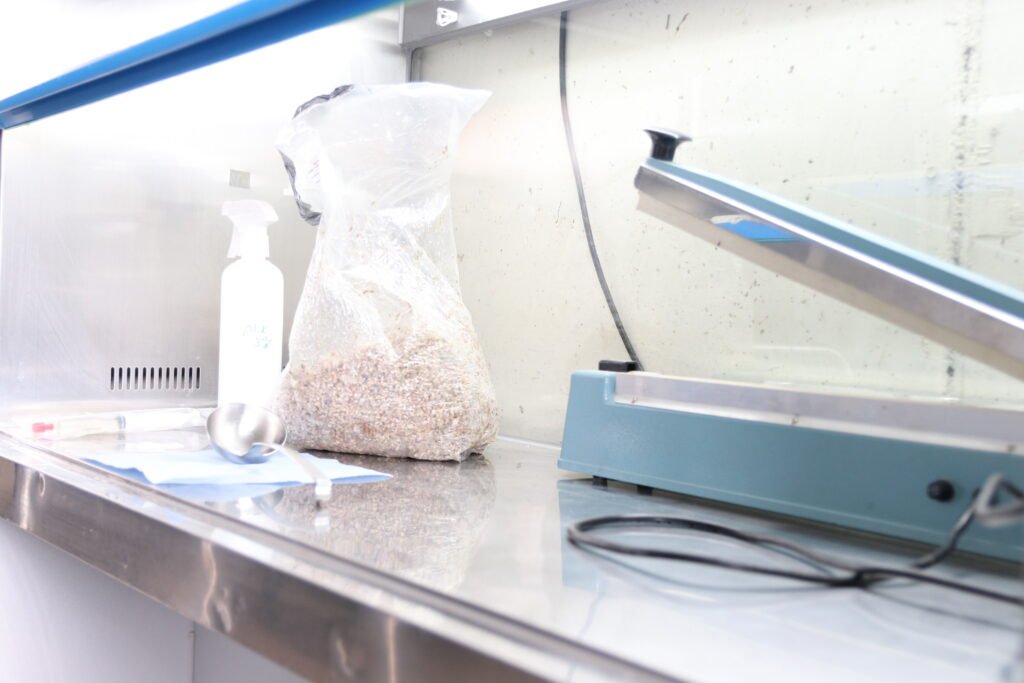
How to prevent contamination
Spot the early signs
Look for unusual colours in the mycelium (green, black, orange or yellow), uncolonised patches in the substrate, a sour or musty smell, slimy patches, or brown spots on the caps. A quick daily check lets you find problems before they spread.
For hobby growers
Start with robust species: oyster mushrooms have fast-growing mycelium that competes well against moulds. A grow kit takes care of preparing the substrate for you. If you can, inoculate in a still air box, which is an upturned container with two holes for your gloved hands. Disinfect work surfaces with 70% isopropyl alcohol. And washing your hands is still one of the most effective hygiene measures there is. Our guide to common mushroom growing mistakes covers more.
For aspiring professionals and side-business growers
Plan realistic time for hygiene from the start. I’d set aside at least a quarter to a third of your production time for cleaning, disinfecting and checking. Invest early in a laminar flow hood and check its filter regularly. Keep the production stages separate: incubation, fruiting and harvest, in different areas if possible. Use sticky traps to spot insects early, and fit insect screens on all air inlets and outlets.
If you buy spawn, use only reliable sources. Good spawn from clean starting material greatly reduces the risk of infection. Stoff’n’s grain spawn and dowel spawn are certified organic and produced under controlled conditions.
3% hydrogen peroxide: If cobweb mould appears early, spraying it with a 3% H₂O₂ solution can help. Mushroom mycelium is much more tolerant of H₂O₂ than most moulds.
Contamination FAQ
Can contaminated mycelium still produce mushrooms?
Sometimes, if the contamination appears late in colonisation and the mycelium has already absorbed most of the nutrients. Small, localised bacterial spots can be removed. Early mould can sometimes be contained with H₂O₂. Your harvest will probably be smaller, though.
Is white mycelium always clean?
No. Early on, Trichoderma and cobweb mould look white and fluffy and resemble mushroom mycelium. Healthy mycelium is denser and more even, and it doesn’t smell musty or sour. Mould often grows faster and spreads across the surface of the substrate rather than through it.
Which mushroom is easiest for beginners, including resistance to contamination?
Oyster mushrooms (Pleurotus ostreatus) are considered the most robust option for beginners. Their mycelium grows very fast and pushes out competitors more effectively than many other species. Shiitake needs more care with the substrate.
What should I do with contaminated jars?
Remove them from the growing area right away, seal them in an airtight plastic bag and dispose of them, but not on the compost. Autoclave the jar afterwards, or at least disinfect it thoroughly with 70% isopropyl alcohol before using it again.
Start with the right spawn
Our certified organic grain spawn and dowel spawn from Schleedorf are produced under controlled conditions for hobby and professional growers. Clean spawn means less risk of contamination from the start.
Or learn more in our mushroom growing course, from preparing substrate to your first harvest.