Care guide · Lion's Mane XXL
Deutsch 🇦🇹
How to grow your Lion's Mane grow kit
Welcome to Stoff'n! This guide takes you step by step through your first – and every following – harvest of Lion's Mane (Hericium erinaceus).
10–15 daysto the first clusters
approx. 90 %humidity
1–2flushes
3–4 weeksrest between flushes
Important: storage before you start
As long as your grow kit is unopened, store it in a cool, dry, frost-free place below 20 °C. Check the best-before date – the kit should be activated by then.
Step by step to your harvest
1. Prepare the kit
Place your grow kit without removing the foil in a humid, cool spot – a bathroom or cellar usually works best. Ideal humidity is around 90 %.
Cut or pierce a small hole at the top of the bag so air can escape, then roll the bag tightly down to the block. Fix the rolled part with tape so the foil fits snugly all round.
2. Cut openings
Cut 3–4 cross-shaped slits of 3–4 cm into the foil around the kit. Use a sharp, clean knife.
3. Growth phase
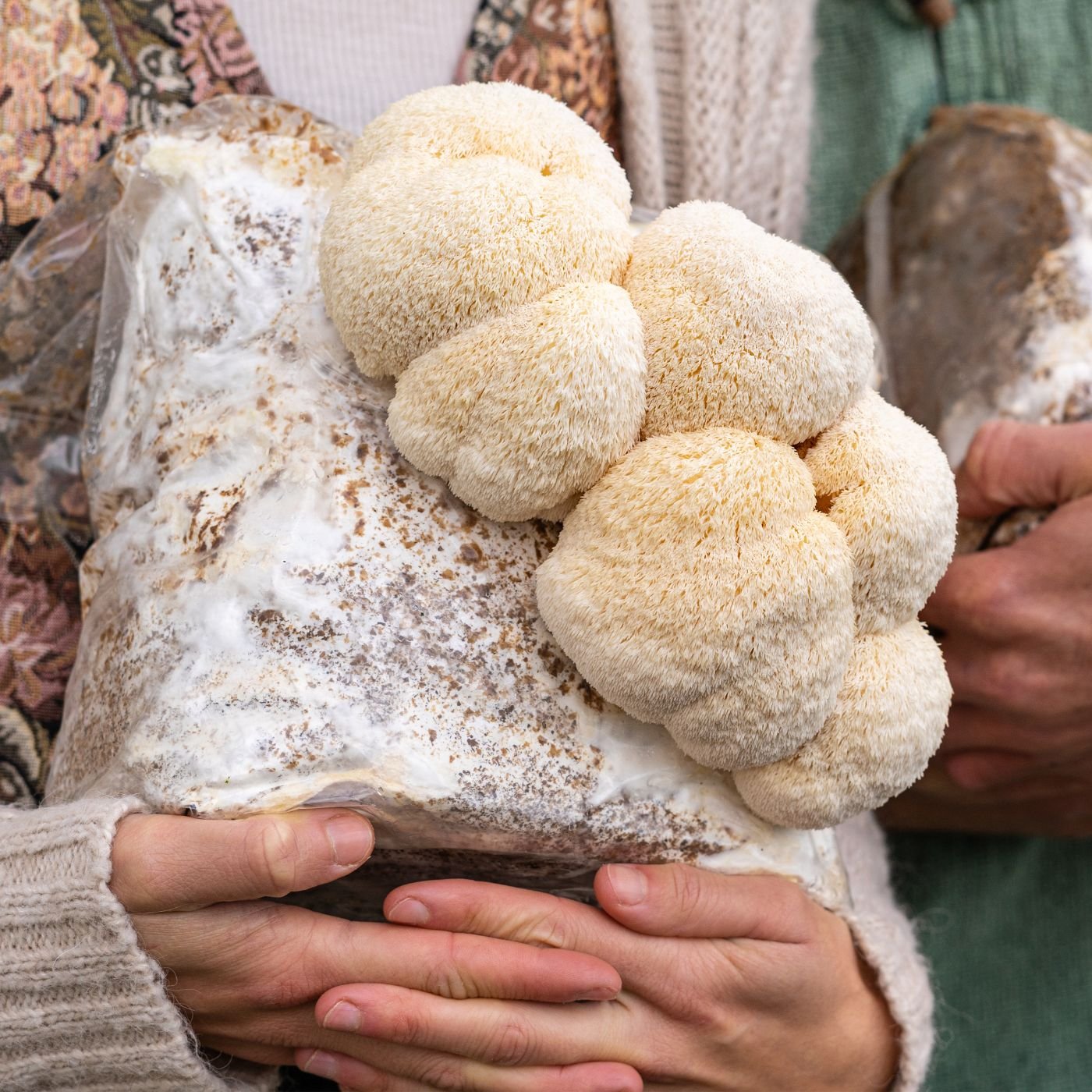
After about 10–15 days, small coral-like fruiting bodies form at the openings. Make sure neither the mushrooms nor the kit dry out. If the clusters feel dry, water them gently with fresh tap water, e.g. using a shower head.
Please note: don't use a plant sprayer – germs can build up inside and harm the mycelium.
4. Harvest
Ripe Lion's Mane mushrooms reach a diameter of 10 to 30 cm. Harvest once they stop visibly growing or the spines start to “frizz”. Always remove the whole fruiting body – only an undamaged cluster keeps growing. The ripe mushroom bruises easily: handle it gently or brown marks will appear.
5. More flushes
After harvesting, your kit needs a rest of 3–4 weeks. Then you can cut 1–2 additional cross-shaped openings. Never remove the foil completely, so the kit doesn't dry out. Seal old openings with tape. One kit gives you 1–2 flushes.
And afterwards? A spent kit is far too good to throw away: remove the foil and add it to your compost or organic waste bin as a valuable organic fertiliser.
Good to know
Our Lion's Mane kits are a natural organic product. Clusters may sometimes form in places other than your slits. In that case, seal the original slits and cut a new opening where the small clusters actually appear.
Ideal conditions for Lion's Mane
Fruiting initiation
- Temperature10–16 °C
- Humidityabove 90 %
During fruiting
- Temperature18–25 °C
- Humidityabove 90 %
- Flushesup to 4
Values from the book “Faszination Pilzzucht” by Sebastian Reindl (Stocker Verlag) and from our own practice at our mushroom farm in Schleedorf, Austria.
Troubleshooting
Clusters turn yellow or brown
Usually a sign of dry air or bruising. Increase the humidity and only touch the mushrooms at the base when harvesting.
Mushrooms grow in other places
No problem – see “Good to know” above: open a slit where the clusters form.
No growth, or only weak growth?
Have a look at our FAQ or get in touch via our contact form – ideally with a photo. We are happy to help.
Enjoying your Lion's Mane
Lion's Mane has a very subtle mushroom flavour and a texture similar to chicken. Sliced and pan-fried until golden, or breaded, it can be pulled apart into fibres – perfect for vegetarian dishes.
FAQ about the Lion's Mane grow kit
When is the right time to harvest?
As soon as the mushroom stops visibly growing or the spines start to frizz. If you wait too long, it turns yellowish and slightly bitter.
Why not use a plant sprayer?
Germs often build up in plant sprayers and can harm the mycelium. Use fresh tap water from a shower head instead.
How do I store the kit before starting?
Cool, dry and frost-free below 20 °C, and activate it before the best-before date.
How long does the harvested mushroom keep?
A few days in a paper bag in the fridge. Avoid pressure marks – the mushroom turns brown there.
Can I grow Lion's Mane in the garden?
Yes, on hardwood logs. That's what our Lion's Mane plug spawn is for.
Want more?
Reorder directly from us, discover more mushroom species or learn how to grow mushrooms yourself in one of our courses.
Questions? FAQ · Contact · All guides