Guide · Organic Reishi plug spawn
Deutsch 🇦🇹
Reishi plug spawn: how to inoculate your logs
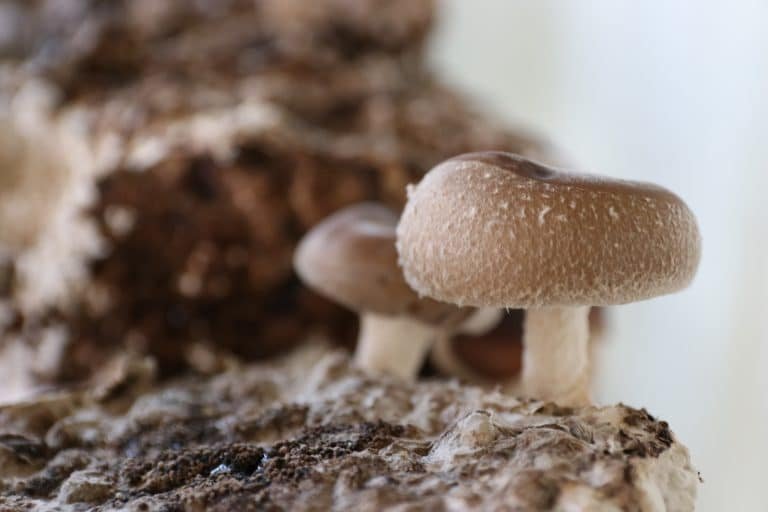
Reishi (Ganoderma lucidum) forms its typical glossy, reddish-brown fruiting bodies on hardwood. This guide takes you through inoculating your logs step by step.

25–50plugs per 1 m log
8–24 monthscolonisation
3–5 yearsof harvests
6–12 monthsplug shelf life, chilled
What you need
- Freshly cut hardwood logs: approx. 1 m long, 10–25 cm diameter, no older than one month
- Organic Reishi plug spawn (100 plugs are enough for 2–4 logs)
- Drill with an 8.5 or 9 mm bit
- Hammer
- Gypsum, beeswax, cheese wax or candle wax for sealing
Until you start: keep chilled
Store the plugs in the fridge until use – they keep for 6–12 months. The fresher they are, the faster the mycelium grows into the wood.
Step by step to your mushroom log
1. Drill holes
Drill 25–50 holes into the log (depending on thickness) in a diamond pattern. The holes should be deep enough for the plugs to sink in completely.
2. Inoculate
Hammer the plugs into the drilled holes.
3. Seal the holes
Seal the inoculation points well with gypsum or beeswax. This protects against drying out and against other fungi.
4. Let it colonise
Stand or lay the inoculated logs outdoors in a shady, damp, sheltered spot, without direct ground contact. Moisten them regularly in the first weeks and months – especially in dry weather.
5. Set up for fruiting
Depending on the wood, the logs are colonised after 8–24 months – the mycelium is then visible on the cut ends. Now bury one end 20–30 cm deep, or lay the logs on the ground half buried. Reishi fruits at cooler temperatures too, but prefers above 20 °C. It grows very slowly: it can take 3–6 months for the fruiting bodies to mature.
Which wood is suitable?
Hardwoods such as oak, beech or alder are suitable for Reishi. Softer hardwoods (e.g. alder, willow) colonise faster but produce for a shorter time. Dense hardwoods (e.g. beech, oak) colonise more slowly but yield over a longer period. Depending on wood and location you can harvest for 3–5 years.
Extra tips
- If the wood is already 1–2 months old, submerge the logs in a rain barrel for 24–48 hours to rehydrate them.
- With older wood, cut a few centimetres off the top and bottom. This removes any fungi that may already have settled there from the air.
- Inoculate ideally in spring or autumn.
Conditions for Reishi
Fruiting initiation
- Temperature14–24 °C
- Humidityabove 90 %
During fruiting
- Temperature14–27 °C
- Humidityabove 85 %
On outdoor logs the mushrooms fruit seasonally – whenever the weather is damp and the temperature suits the species.
Values from the book “Faszination Pilzzucht” by Sebastian Reindl (Stocker Verlag) and from our own practice at our mushroom farm in Schleedorf, Austria.
Troubleshooting
No mycelium on the cut ends after a year
Dense hardwood can take up to 24 months. Keep the log moist and give it time. White mycelium on the cut ends shows it is colonised.
Other fungi are growing on the log
Foreign fungi usually come in through old wood or open cut surfaces. That's why you should use fresh wood and seal all holes well.
No growth, or only weak growth?
Have a look at our FAQ or get in touch via our contact form – ideally with a photo. We are happy to help.
The detailed illustrated guide is in our article Guide for mushroom cultivation on logs.
FAQ about plug spawn
How many plugs do I need?
For a log 1 m long and 10–20 cm in diameter, 25–50 plugs. So 100 plugs are enough for 2–4 logs.
When will I get the first mushrooms?
Depending on the wood, after 8–24 months. After that the log produces for many years.
Why does the wood have to be fresh?
Fresh wood has no foreign fungi yet and enough moisture. Ideally the wood is no older than one month.
Can I use softwood (conifers)?
No, for Reishi please only use hardwood.
Can I eat Reishi like other mushrooms?
No. The fruiting body is corky and very bitter – it's not a mushroom for the frying pan.
Why does my Reishi look like antlers?
With little fresh air, Reishi forms the so-called antler shape. With more fresh air it develops a larger, flat cap.
Want more?
Reorder directly from us, discover more mushroom species or learn how to grow mushrooms yourself in one of our courses.
Questions? FAQ · Contact · All guides