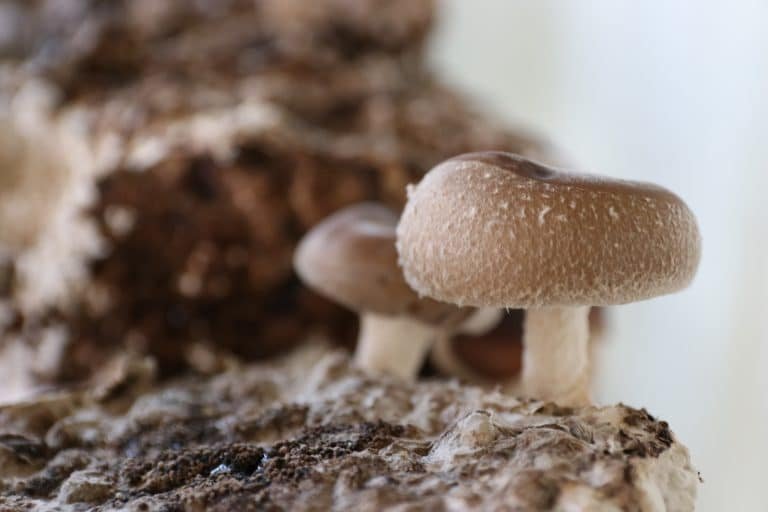
Guide · Home Mushroom Growing Kit
Deutsch 🇦🇹
How to use your Home Mushroom Growing Kit
With straw pellets, organic spawn and three filter bags you can grow your own oyster or lemon oyster mushrooms – no experience needed. Here is the step-by-step guide.

3 bagsof 0.5 kg straw pellets
500 gorganic spawn
approx. 4 weekscolonisation
3 monthsspawn shelf life in the fridge
You will also need
- 3 litres of hot tap water (1 litre per bag)
- protective gloves
- 3 cable ties or clips
- a sharp, clean knife
- a spray bottle with fresh water
Good to know: storing the spawn
Keep the spawn in the fridge until you start – it keeps for about 3 months. The fresher you use it, the faster it grows.
Step by step to your harvest
1. Prepare the substrate
Pour one litre of hot tap water onto the pellets in each filter bag. Wear protective gloves and work carefully – the hot water often makes the rim fold inwards. Hold the bag closed at the top with one hand and mix the pellets with the other until they have all broken down. Then fold over the top of the bag and stand the bag on the fold so that no air gets in. Repeat for all three bags.
2. Inoculate
12–24 hours later, once the substrate has cooled below 25 °C, divide the enclosed spawn between the three bags. Work with clean hands or gloves.
3. Close and shake
Close each bag above the filter with a cable tie, leaving as much air as possible above the substrate. Then shake the bags well to spread the spawn through the substrate.
4. Let it colonise
Leave the bags at room temperature (20–24 °C) for about four weeks. The substrate gradually turns white.
5. Fruiting
Once a bag is completely white, cut 4–8 crosses of about 2 cm into the plastic. The mushrooms will grow out of these openings. Now move the bags to a bright, cooler and humid spot out of direct sunlight, and mist the openings and later the mushrooms once a day.
6. Harvest
5–7 days after the first mushrooms appear, or as soon as the caps start turning upwards, it's harvest time. Always take the whole cluster.
Ideal conditions by variety
Oyster mushroom (Pleurotus ostreatus)
Colonisation
- Temperature20–24 °C
- Duration14–22 days
Fruiting initiation
- Temperature6–15 °C
- Humidity90–95 %
During fruiting
- Temperature5–20 °C
- Humidityabove 85 %
- Fresh air (CO₂)< 800 ppm
- Light800–1500 Lux, indirect
- Flushes2–4
Lemon oyster mushroom (Pleurotus citrinopileatus)
Colonisation
- Temperature20–24 °C
- Duration14–22 days
Fruiting initiation
- Temperature16–25 °C
- Humidity90–95 %
During fruiting
- Temperature16–25 °C
- Humidity85 %
- Fresh air (CO₂)< 1000 ppm
- Light800–1500 Lux, indirect
- Flushes2–4
Values from the book “Faszination Pilzzucht” by Sebastian Reindl (Stocker Verlag) and from our own practice at our mushroom farm in Schleedorf, Austria.
In short: the oyster mushroom likes it cool for fruiting (autumn, winter, spring, a cool cellar), while the lemon oyster needs warmth (16–25 °C) and is the right choice for summer or a warm home.
Troubleshooting
Green, black or pink spots in the bag
This is contamination (mould). Don't open the affected bag – dispose of it closed. Read more in common mushroom growing mistakes.
The substrate doesn't turn white
If the substrate was still too warm (above 25 °C) when inoculated, the spawn may be damaged. Rooms that are too cold (below 18 °C) also slow colonisation considerably.
No growth, or only weak growth?
Have a look at our FAQ or get in touch via our contact form – ideally with a photo. We are happy to help.
Enjoying your mushrooms
Oyster mushrooms are versatile – fried, breaded, in a stir-fry or in soup. Lemon oysters taste slightly fruity and are very delicate: best used fresh and only briefly fried.
FAQ about the Home Mushroom Growing Kit
Why does the substrate need to cool down?
The spawn is alive and can be damaged above 25 °C. So wait 12–24 hours until the substrate has cooled.
How often can I harvest?
Each bag usually gives 2–4 flushes. Between flushes, the substrate needs one to two weeks of rest and regular misting.
Can I refill the kit?
Yes. Straw pellets, filter bags and spawn are also available separately from us. The instructions stay the same.
Where do the mushrooms grow best?
In a bright spot out of direct sunlight, with high humidity – bathroom, cellar or a cool room.
What do I do with the substrate afterwards?
Compost, raised bed or organic waste bin – it's a valuable organic fertiliser.
Want more?
Reorder directly from us, discover more mushroom species or learn how to grow mushrooms yourself in one of our courses.
Questions? FAQ · Contact · All guides